
Social-Environmental Opportunities and Tradeoffs of Agroforestry
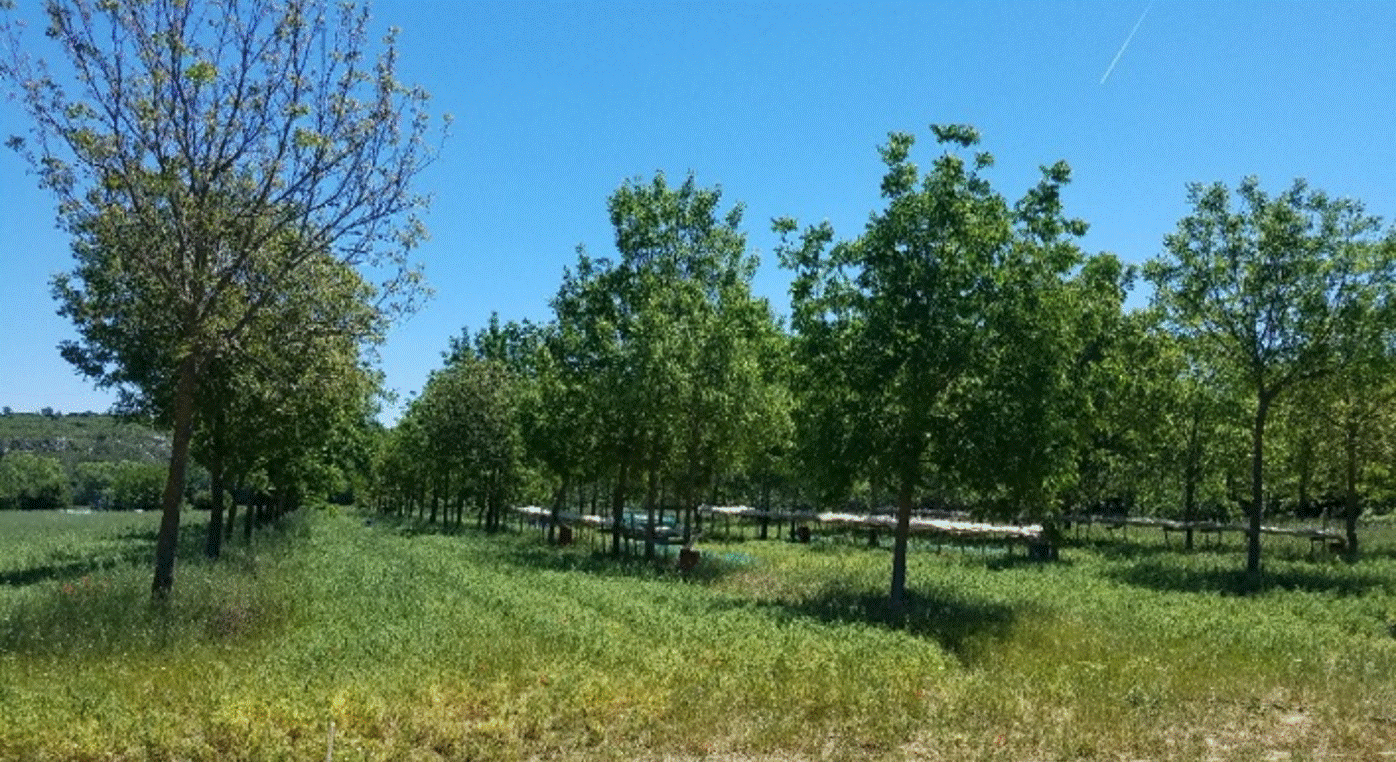
Expanding Agroforestry in the US Midwest
Sustainable forestry and agricultural practices like agroforestry are necessary to ensure global food security, mitigate climate change, conserve biodiversity, and provide ecosystem services. Such practices can also boost economic profitability and enhance human well-being. Agroforestry, defined as the integration of trees into crop and livestock systems, is widely promoted as a sustainable land use practice. However, the rate of adoption of agroforestry practices remains low due to social, economic, ecological, and political barriers. Consequently, we miss a critical opportunity to advance both environmental and social sustainability goals. Scientific understanding based on an interdisciplinary approach to address ecological, economic, social, and political interactions is needed to spur appropriate expansion of agroforestry practice.
The goal of this research is to advance agroforestry knowledge and policy by mapping the suitability of agroforestry practices and developing a model to predict priority areas for targeting agroforestry across the United States (US) Midwest (1, 10). Additionally, we assessed the opportunities and barriers for agroforestry practice and policy in the US Midwest through field-based inquiry (7, 8). We conducted semi-structured interviews with farmers, ranchers, and program administrators in Illinois to better understand how they perceive agroforestry and start untangling the opportunities and barriers to expanding agroforestry. Specially, we used a nature values framework (7) and place attachment theory (9) to explore adoption decision-making and understand the tradeoffs between social-economic and environmental factors in agroforestry adoption decisions.
Social-Environmental Impacts of Agroforestry
Agroforestry is widely promoted as a multifunctional solution for agricultural productivity and environmental conservation. We systematically mapped the literature on the impacts of agroforestry practice and policy interventions on ecosystem service and human well-being outcome globally (3, 5, 6). Our reviews demonstrated that there is substantial evidence on the impacts of agroforestry practices on regulating ecosystem services. In contrast, evidence on the economic and social outcomes of agroforestry practices, such as profitability, was very limited. There is also a paucity of evidence on the impacts of policy interventions to promote agroforestry. The results highlight the need for additional evaluation of policies as well as the economic and social impacts of agroforestry practices to inform future policy and practice.
Additionally, we systematically reviewed and conducted meta-analyses on the impact evaluations conducted for agroforestry interventions in low- and middle-income countries (4). We found positive overall effects of agroforestry interventions on yield and incomes, though the effect size and sign were context-specific. We are currently collaborating to systematically map the literature on the impacts of climate smart agriculture policies (2).
Related Publications:
1. Castle, S.E., Miller, D.C., & Wardropper, C. (2025). Mapping the social-ecological suitability of agroforestry in the US Midwest. Environmental Research Letters, 20(2), 024041. doi.org/10.1088/1748-9326/adab09
2. Amadu, F., Castle, S. E., Munien, S., Jackson, B. A., Walker, R. N., Stanton, J., Reycraft, K., Mays, T., & Corfee-Morlot, J. (2024). Understanding the Impacts of Climate Smart Agriculture Interventions on Climate Policy Outcomes in Low- and Middle-Income Countries: An Evidence and Gap Map Protocol. a Other Configurative Reviews (e.g. evidence maps or scoping reviews). PROCEED-24-00285. https://doi.org/10.57808/proceed.2024.32
3. Castle, S. E., Miller, D. C., Merten, N., Ordonez, P. J. & Baylis, K. (2022). Evidence for the impacts of agroforestry on ecosystem services and human well-being in high-income countries: a systematic map. Environmental Evidence, 11(1), 1-27. doi.org/10.1186/s13750-022-00260-4
4. Castle, S.E., Miller, D.C., Ordonez, P.J., Baylis, K., & Hughes, K. (2021). The Impacts of Agroforestry Interventions on Agricultural Productivity, Ecosystem Services, and Human Well-Being in Low- and Middle-Income Countries: A Systematic Review. Campbell Systematic Reviews, 17(2), e1167. doi.org/10.1002/cl2.1167
5. Miller, D.C., Ordonez, P.J., Brown, S.E., Forrest, S., Nava, N.J., Hughes, K., & Baylis, K. (2020). The Impacts of Agroforestry on Agricultural Productivity, Ecosystem Services, and Human Well-Being in Low- and Middle-Income Countries: An Evidence and Gap Map. Campbell Systematic Reviews, 16, e1066. doi.org/10.1002/cl2.1066
6. Brown S.E., Miller D.C., Ordonez P.J., & Baylis K. (2018). Evidence for the Impacts of Agroforestry on Agricultural Productivity, Ecosystem Services, and Human Well-Being in High-Income Countries: A Systematic Map Protocol. Environmental Evidence, 7(24), 1-16. doi.org/10.1186/s13750-018-0136-0
Works In Progress:
7. Castle, S. E., Ramirez, A., Miller, D. C., Wardropper, C. (in prep). Exploring the role of nature values in agroforestry adoption decision-making. Draft available upon request.
8. Castle, S. E., Ramirez, A., Miller, D. C., Wardropper, C. (in prep). Agroforestry transitions: opportunities and barriers to agroforestry adoption in Illinois.
9. Ramirez, A., Castle, S. E., Wardropper, C. (under review). Influence of place attachment on agroforestry adoption. Agroforestry Systems. Draft available upon request.
10. Castle, S. E., Ramirez, A., Miller, D. C., Wardropper, C. (accepted). Agroforestry for the Midwest: Developing A Social-Ecological Suitability Decision Support Tool. Journal of Extension. Draft available upon request.
– Castle, S., Ramirez, A., Miller, D., & Wardropper, C. (2024). Agroforestry Suitability Tool User Guide. Zenodo. https://doi.org/10.5281/zenodo.14194395
Forest Cover and Forest Cover Change
Impacts of Tren Maya in Mexico’s Yucatán Peninsula
The Yucatán Peninsula in Mexico is a biodiversity hotspot and home to extensive forest ecosystems critical for climate regulation. The Maya Train Project (“Tren Maya”) is a 1,500-kilometer train project looping around the peninsula. Tren Maya represents one of the most ambitious infrastructure initiatives in Mexico, aimed at boosting tourism and economic development in the Yucatán Peninsula. However, the environmental consequences of this project, such as deforestation and forest fragmentation, remain underexplored.
Our study seeks to quantify the spatio-temporal forest cover change dynamics attributable to the project using an econometric approach and geospatial analysis. We utilize the Continuous Change Detection and Classification (CCDC) algorithm and Harmonized Landsat and Sentinel-2 imagery with Hansen Forest Cover Change data to monitor sub-annual changes in forest cover. The CCDC algorithm enables the detection of forest loss events with temporal granularity, which allowed us to create a quarterly panel dataset spanning 2015-2023. This dataset includes forest cover and covariate metrics for treated areas (i.e., the region along the true Tren Maya route) and control areas (i.e., the regions along the planned – but not constructed – route, or other areas with similar ecological and socioeconomic characteristics but no direct exposure to the project). Our analysis employs a difference-in-difference event study approach, leveraging the staggered rollout of construction activities across train segments, to estimate the causal impact of Tren Maya on forest cover. We show the environmental tradeoffs associated with large-scale infrastructure projects.
Forest Cover and Change Product Comparison
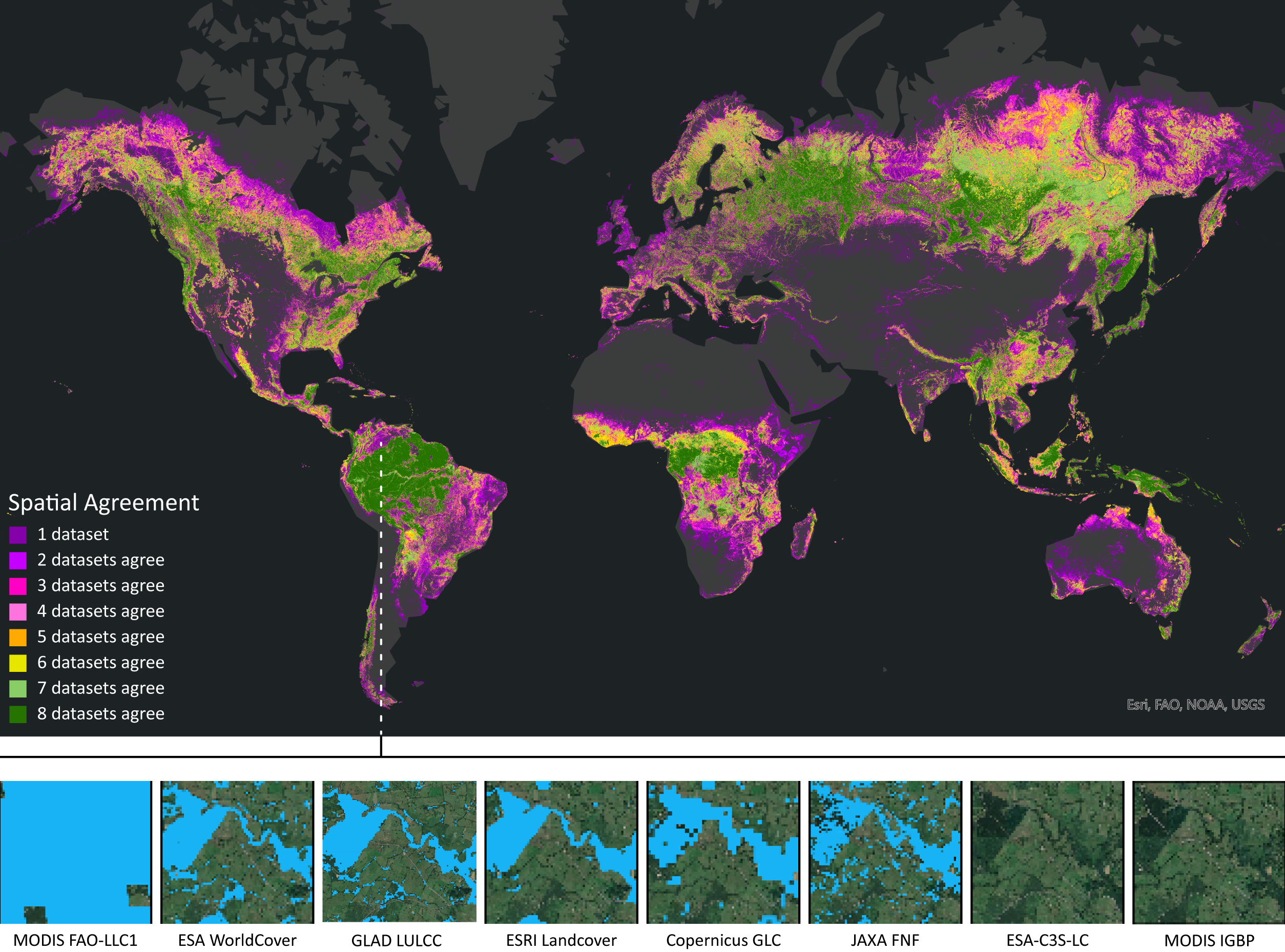
The availability of remotely sensed global forest and tree cover datasets is rapidly expanding. These datasets are being integrated into work-streams by researchers and stakeholders working on diverse forest sustainability problems, including deforestation monitoring and the evaluation of forest-related policies. In this project, we provided an overview of currently available global forest cover data (1). We analyze their spatial congruence and demonstrate the implications that different data choices have for carbon sequestration estimates, rural development policies, and mapping of threatened species habitat over time. We find three key results: 1) only 26% of forest pixels are in full agreement across seven forest datasets, 2) there is significant variation in overall spatial agreement between biomes, with especially low agreement for dry forest biomes, and 3) there are massive implications for the estimates you generate for policy-relevant social and ecological applications for these data. Data users need to be acutely aware of how different datasets define and measure forests and consider using multiple datasets to generate a range of estimates to address potential spatial biases and inconsistencies.
Related Publications:
1. Castle, S.E., Oldekop, J., Newton, P., Baylis, K., & Miller, D.C. (2026). Global forest cover dataset incongruence creates high uncertainties for sustainability science. One Earth, 9. https://doi.org/10.1016/j.oneear.2025.101558.
Works in Progress:
2. Sanford, L., Castle, S.E., Martinez-Alvarez, C. B. (in prep). Deforestation from the Tren Maya Railway: Evidence from Satellite-Based Monitoring.
Forests, Trees, and Poverty
The alleviation of global poverty is a major objective of the 2030 UN Sustainable Development Goals (notably SDG1 “to end poverty in all its forms everywhere”). Many rural people experiencing poverty often rely on forests and tree-based systems, such as agroforestry, suggesting the existence of links between such systems and poverty outcomes. We reviewed the evidence on the roles of forests and tree-based systems in poverty dynamics (4, 6). We also evaluated the literature on forest- and tree-based policy levers to answer the question: which forest management policies, programmes, technologies and strategies have been effective at alleviating poverty? (3,5)
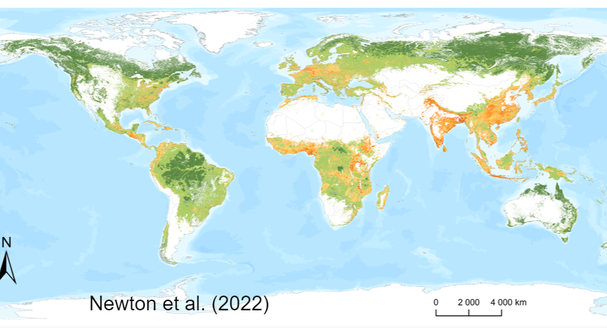
In partnership with the UN Food and Agriculture Organization (FAO), we mapped the number and spatial distribution of forest-proximate people globally (1,2). Mapping the spatial relationship between forests, trees and the people that live in and around them is key to understanding human-environment interactions. Quantifying spatial relationships between humans and forests and trees outside forests can help decision-makers develop spatially explicit conservation and sustainable development indicators and policies to target priority areas.
Our recent efforts have been on mapping the number and spatial distribution of forest-proximate people in poverty using new, high resolution gridded poverty data. Adding people, especially more vulnerable and like more forest-dependent populations, onto the map can help better direct research and policy that jointly addresses environmental change and poverty alleviation.
Related Publications:
1. Newton, P., Castle, S.E., Kinzer, A.T., Miller, D.C., Oldekop, J.A., Linhares-Juvenal, T., Pina, L., Madrid, M. & de Lamo Rodriguez, J. 2022. The number of forest- and tree-proximate people – A new methodology and global estimates. Forestry Working Paper No. 34. Rome, FAO. http://www.fao.org/documents/card/en/c/cc2544en
2. FAO. 2022. The State of the World’s Forests 2022. Forest pathways for green recovery and building inclusive, resilient and sustainable economies. Rome, FAO. https://doi.org/10.4060/cb9360en (Castle, S.E. contributing author to Chapter 2)
3. Hajjar, R., Newton, P., Ihalainen, M., Agrawal, A., Alix-Garcia, J., Castle, S. E., Erbaugh, J. T., Gabay, M., Hughes, K., Mawutor, S., Pacheco, P., Schoneveld, G., & Timko, J. A. (2021). Levers for alleviating poverty in forests. Forest Policy and Economics, 132, 102589. doi.org/10.1016/j.forpol.2021.102589
4. Razafindratsima, O. H., Kamoto, J. F. M., Sills, E. O., Mutta, D. N., Song, C., Kabwe, G., Castle, S. E., Kristjanson, P. M., Ryan, C. M., Brockhaus, M. & Sunderland, T. 2021. Reviewing the evidence on the roles of forests and tree-based systems in poverty dynamics. Forest Policy and Economics, 131, 102576. doi.org/10.1016/j.forpol.2021.102576
5. Hajjar, R., Newton, P., Ihalainen, M., Agrawal, A., Gabay, M., Alix-Garcia, J., Brown, S. E., Erbaugh, J. T., Hughes, K., Mawutor, S., Pacheco, P., Schoneveld, G., Song, C., & Timko, J. (2020). Levers for Alleviating Poverty in Forests and Tree-Based Systems. In D. C. Miller, S. Mansourian, & C. Wildburger (Eds.), Forests, Trees and the Eradication of Poverty: Potential and Limitations. A Global Assessment Report (Vol. IUFRO World Series Volume 39, pp. 240 p.). Vienna: International Union of Forest Research Organizations (IUFRO). www.iufro.org/news/article/2020/10/15/world-series-vol-39-forests-trees-and-the-eradication-of-poverty-potential-and-limitations/
6. Razafindratsima, O. H., Kamoto, J., Sills, E. O., Mutta, D. N., Song, C., Sunderland, T., Kabwe, G., Ryan, C., Brown, S. E., Kristjanson, P. M., Brockhaus, M., Logo, P. B., Mihigo, B.-P. N., Ongolo, S., Xiao, J., & Zhao, Y. (2020). Forest-Poverty Dynamics: Current State of Knowledge. In D. C. Miller, S. Mansourian, & C. Wildburger (Eds.), Forests, Trees and the Eradication of Poverty: Potential and Limitations. A Global Assessment Report (Vol. IUFRO World Series Volume 39, pp. 240 p.). Vienna: International Union of Forest Research Organizations (IUFRO). www.iufro.org/news/article/2020/10/15/world-series-vol-39-forests-trees-and-the-eradication-of-poverty-potential-and-limitations/
7. Ge, X., Brown, S.E., Rana, P., Varshney, L.R. and Miller, D.C., 2023. Network Analysis as a Tool for Shaping Conservation and Development Policy: A Case Study of Timber Market Optimization in India. arXiv preprint arXiv:2304.13907.
Works in progress:
1. Farrae, M., Castle, S.E., Miller, D.C. (in prep). Forest-proximate people in poverty for Pakistan.
2. Castle, S.E., Alencar, L., Baylis, K., Costa, L., Kinzer, A., Nakamura, K., Newton, P., Oldekop, J., Tripathy, P., and Miller, D. (in prep). Global estimates and spatial distribution of forest-proximate people in poverty.
Voluntary Carbon Markets
High-Integrity Carbon Markets
We are working as a part of a joint initiative – SHIFT CM – between the Yale Applied Science Synthesis Program and The Nature Conservancy working towards high-integrity carbon markets using natural climate solutions. I am specifically leading a digital Monitoring, Reporting and Verification (dMRV) working group aiming to provide guidance on bringing in satellite and other types of remotely sensed data to establish project baselines, track changes in carbon storage, monitor leakage and permanence, and improve project impact evaluation, including the co-benefits (or tradeoffs) of carbon projects.
We also aim to provide guidance on data ethics in using dMRV approaches in carbon markets, including understanding how dMRV can complement – rather than overwrite – community knowledge, and provide guidance on obtaining free, prior, and informed consent in dMRV applications.
REDD+ specification curve
We are collaborating with the SPIRES lab to evaluate the impacts of global REDD+ projects using different specifications of synthetic controls and causal forests to try to understand the discrepancy between estimates generated by project developers and those generated by academic researchers. We aim to explore the differences in estimation techniques and provide recommendations for improving carbon market assessment approaches.